The initial idea of Bondsongs was instigated by the theatre and film director Nick Hamm who, with his co-director - now theatre producer Brigid Larmour - was looking for material for the 1982 RSC Youth Festival sponsored by W.H. Smith. He heard me practicing the piano in the old RSC Conference Hall late one night and suggested I compose some music to the rarely performed theatre poems and songs of the playwright Edward Bond of whom Nick himself was a devoted admirer and protégé. Nick recommended that they be sung by one of the girls in the 1982 company who he'd heard singing at a party and who had a pretty amazing voice.
She was also a highly acclaimed actress and well known from the popular television science fiction series Blake's Seven.
When I played Nick some rough ideas a few days later, he asked me if I'd write the music for a one act play he was producing for the festival, also by Edward Bond, called Derek. I happily accepted and when I'd finished that to Nick's satisfaction, I returned to the original idea - The Bondsongs.
I set to work and in four weeks, I had composed ten songs, which Nick felt was enough for a forty five minute programme and I called on my old percussion colleague Nigel Garvey and the extremely gifted cellist Julia Vohralik. Both Julia and Nigel were very tolerant of my very loose sense of composition and the fact that I couldn't write a note of music and it is a tribute to their musicianship that the three of us formed a pretty tight musical ensemble consisting variously of acoustic and electric guitars, cello, bass, conga drums, xylophone, vibraslap, recorder and piano.
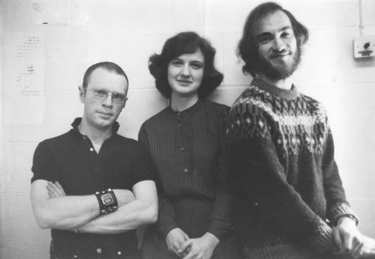
DSP, JULIA AND NIGEL
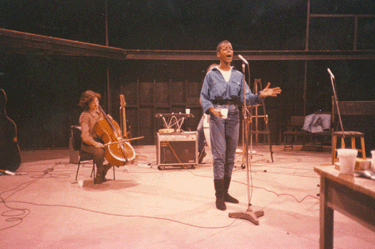
Rehearsals were a very enjoyable affair; myself and our leading lady took enormous risks with the interpretation of the songs giving them an often anarchic theatrical energy complimented by the rooted musical anchorage of Nigel and Julia. Our theory was that although what we were attempting was a frightening prospect, the worst that could happen was failure and embarrassment - so if we decided beforehand that embarrassment and failure were merely the opposites of success and triumph - which we weren't really interested in either - then each pair of 'abstracts' would cancel the other out; away with the pass/fail ethic! Energy, commitment to the material and sincerity in performance were the realities in which we could trust. If "going for it all out'', was the only way, then "go for it all out" we would. Our embracing of danger would, in fact, be our salvation if not, paradoxically, our security blanket. Bridgid and Nick came to as many as rehearsals as they could, lending support and encouragement and several members of the acting company dropped by from time to time, if only to see for themselves where the noise of drums and electric guitar was coming from. The RSC were currently rehearsing Edward Bond's play Lear, and, as the playwright himself was in Stratford to attend their sessions, Nick asked Edward along to hear our musical interpretation of his poems and songs.
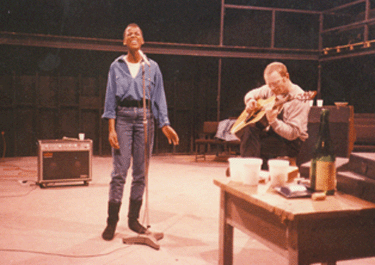
In rehearsal
We performed a rehearsal of our entire set to the kindly and gracious gaze of Mister Bond himself although his apparent gentleness could not wholly disguise a serious penetrating attention to our every syllable, inflection and musical note. While he professed a total lack of understanding with regard to the process of musical creation [I think he's mistaken], his care and professional respect for the written word was utterly rigorous. Without giving too much away, Edward Bond gave us his comradely nod of approval and promptly took us for a drink at the Dirty Duck. Much as I longed to talk to Edward about the approach I had taken to setting his words to music, he simply advised me, a keen twenty seven year old, to learn to let the pieces speak for themselves.
To have Edward's approval was a great boost to our confidence but we knew that by the very nature of the task we had set ourselves, the public performance would be neither an effortless, nor painless night's work.
On the day of our first performance, we all met as a group and assured each other that not one of us would let the other down; any risks in performance would be met with total support and any mistakes or ''fluffs" embraced positively by the whole group. I would open the show with two solo songs as a prelude and then the full band would come on to launch the evening proper.
Before our first performance we were petrified but prepared to put ourselves on the line no matter what and a full house gave us a reception we were truly unprepared for.
Nick and Brigid were the first backstage to congratulate us along with theatre directors Barry Kyle and Bill Alexander. Tickets sold out for the next performance and an extra late night concert was added to the RSC W.H. Smith festival programme.
I had asked Leo Liebovici, the RSC sound engineer who sat at the mixing desk at all our performances to record a cassette of the first show and this was mysteriously copied and passed around to various members of the company. We didn't mind. We took it as a compliment. The acting company were enthusiastically appreciative of our work and the special late night performance was packed out by almost exclusively our fellow members of the RSC. However, as the audience knew every song that came up and sometimes sang along, our performance risks were less likely to fail - our appreciative audience wouldn't let them - and we were soon aware of becoming a little too comfortable with our interpretations.
As the company was due to take its repertoire of plays for a six week residency at Newcastle Upon Tyne, Nick, Brigid and our band decided to play five fringe dates and a special school performance at Ashington College. I composed the music for a further four pieces which extended our show to over sixty minutes and we rehearsed again, riding on the confidence of our sell out Stratford shows.
The cold January of 1983 was a harsh change in climate to the warm and lazy Warwickshire summer and while the performances of Nick's highly acclaimed production of Derek were well attended, the bookings for our five shows were poor.
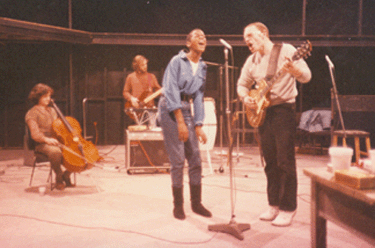
The Bondsongs failed to entice the Newcastle audiences to the Gulbenkian theatre. The reception was tepid, and although several people came backstage afterwards to express their appreciation, we felt very vulnerable and sensitive, giving our 'all out risk' performances to a more than half empty theatre. A crushing review in the local paper dampened our spirits - particularly so in that it was hurtful and unjustly critical of our singer who gave everything in her energetic and soulful interpretations no matter how small the audience [seven people only on one particular night] and accused me of writing dull, monotonous dirges which caused him to leave the theatre 'wishing that the poems had simply been read aloud.
I escaped lightly by comparison. The Ashington College show, though, was a joy - you can always count on students - even at eleven o'clock in the morning!
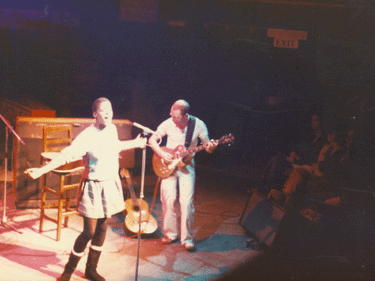
We carried on, faithful to our original 'dangerous' intentions. One couldn't coast or 'half-perform' the Bondsongs and the demands of the musical arrangements were so exacting as to utterly humiliate any half-hearted attempts to meet them.
The tapes of the shows left us a little demoralised [such sparse applause after we had screamed our lungs out] and when we finished the series of concerts and a televised performance of one of the songs ''On Leaving The Theatre' for Tyne Tees, we consoled ourselves with a 'Band Supper' at a Grey Street Bistro opposite Newcastle's Theatre Royal and swapped stories of the earlier Stratford concerts, rehearsal 'hiccoughs' and goofs and the odd magical moments of togetherness.
When the RSC repertoire arrived in London, we were all consumed in its rehearsals. New cast members had to be slotted in and we were all due to appear in new productions, especially planned for our London season. Nigel, our percussionist, returned to his Stratford base for the new season there and so any prospect of re-mounting The Bondsongs in London would involve rehearsing in a new drummer. We had all missed our London homes so much over the past year in Stratford and Newcastle that after twelve to thirteen hour days of rehearsing and performing plays, we were glad to return to them, exhausted.
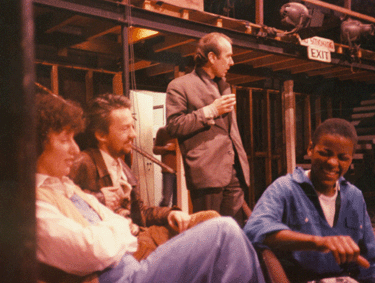
Our singer was rehearsing a new play The Custom Of The Country, I was rehearsing Cyrano de Bergerac and Julia, our cellist organised her time between performing, recording and appearing in Much Ado About Nothing which only came into the London repertoire every two weeks or so. Also, we all lived in different parts of London which made rehearsals even less convenient, compared to our very close proximity in the tiny village of Stratford Upon Avon. As the weeks turned to months, the months into a year The Bondsongs lay dormant and although Nick and Brigid organised another RSC Fringe Festival called 'Thoughtcrimes' in London and invited us to play again, we knew that in reality it was impossible.
Nick's production of Derek was re-mounted for a brief educational tour and then filmed for Thames Television but with a different cast because of the non- availability of the original team due to their heavy RSC commitments [however, thanks to the late Margaret Ramsay and Edward himself, they used my music which I spent two days recording for them].
A month later Í was commissioned by Nick to write the music for another Edward Bond play, Red, Black and Ignorant which was to become the first play in the impending major Bond trilogy 'The War Plays' but as I was stretching my time to the limit to be a part of those projects, resurrecting The Bondsongs remained an unlikely prospect although, without Nigel and Julia, we performed two songs from the original show as a 'one-off special' at a CND benefit night at London's Phoenix Theatre along with The Darts, Girlschool and the legendary Roy Harper. Thanks to Nick Hern and Micheline Steinberg at Margaret Ramsay's office, Methuen Plays offered to publish my music to Derek and Red, Black and Ignorant which has appeared in subsequent editions of those plays, as well as The War Plays, published in 1985.
When almost eighteen months had passed since our final band performance in Newcastle, I decided to record six of the original fourteen songs for posterity along with some newer compositions [which were intended for the original ensemble] in a studio I used quite regularly. Half of the band was back in Stratford and Julia had since left the RSC so I sang and played all of the instruments myself, hiring Tony McVey - the resident RSC London drummer and old friend - to do the percussion parts. I recorded about an album's worth of material as a personal record of the project. Edward was extremely helpful and supportive of the idea. I sent him tapes of each of my sessions and we spoke regularly on the telephone for about an hour every Saturday morning.
It was not until November of 1984 that the idea of performing The Bondsongs resurfaced. The RSC was now in New York and, with Cyrano de Bergerac and Much Ado About Nothing enjoying a five month run at Broadway's Gershwin Theatre, during the days I found myself with time on my hands. Brigid was the only other member of the Bondsongs 'originals' that was still a part of that company. She suggested I should develop a solo show without departing from or letting go of the original idea and try some new arrangements of existing Bondsongs along with some newer pieces and perform it at an Off Broadway' venue whose artistic director she knew.
I duly performed a solo show at the First American Children's Theatre [F.A.C.T.] in New York comprising of mostly new Bondsongs, interspersed with a few of the songs from the 'band show' and the songs from Edward's plays Derek and The War Plays.
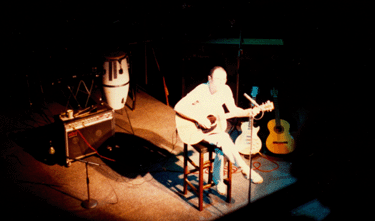
The audience was very warm and, in spite of the fact that I gashed my left hand rather badly while changing strings earlier that day and which bled profusely during the performance,
I finally enjoyed a very nerve-wracking experience. As usual, I recorded the event and Brigid suggested I do the show again at the Kennedy Centre, Washington - the final RSC venue of the tour. In Washington, I was staggered by the size of the audience I played to - more than two hundred! - and the reception encouraged me into reviving the Bondsongs in some form either with the band or, depending on the others' availability, on my own and organising a repertoire that could incorporate either one of those two performance formats.
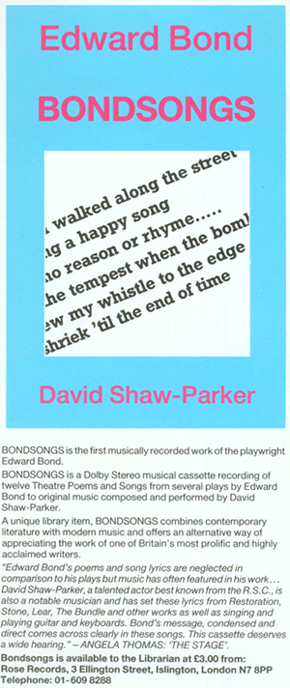
Also, as so many people had asked if a recording was available, I decided to release the studio recordings I had made at my own expense under the title 'BONDSONGS'. Although memories were dim of the original project some two and a half years later, the album sold well and was stocked in various London stores and at the RSC and National Theatre book shops.
London critics would be in attendance now, as would influential figures in the theatre profession and although none of us wanted to recognise this as a pressure, it was certainly a creeping form of subliminal intimidation. We performed well, I think, and as honestly as we could. Tony McVey fitted in superbly as a replacement for Nigel and though the audience was generous and supportive, we all felt afterwards as if we had done an audition rather than a performance. There was a great misunderstanding, too, because the recording I had made was on sale in the foyer bookshop and audiences were confused as to why there wasn't a recording of the full band, why there were songs on the recording that weren't in the show and vice-versa. Again, our lives and careers took us all separate ways. I went off to record a television series for the BBC and the rest remained variously at the Royal Shakespeare Company, in Stratford, in London, in Newcastle.
I didn't want the project to disappear totally and I performed a solo concert at the now defunct Taylor's Theatre Club in London's East End as well as a week of poorly attended late night solo concerts at the Lyric Studio, Hammersmith and I played three songs from the album for a Friends of The Earth benefit at Saint James Church in Piccadilly.
The recording sold moderately well - I kept adding material to the Bondsongs repertoire and even now I have enough material for at least two albums. The Bondsongs was a very special product from a very special year with one of the best Stratford companies I can remember in my nine years with the RSC which I still consider myself lucky to have been a part of. I have never known such a close, harmonious and inter-supportive group of human beings. They, as well as the four of us, gave the Bondsongs their love and their support - without them it wouldn't be the treasured personal memory it is. It's raw energy was what made it vibrant and alive. As a show it was abrasive, harsh, uncompromising - often ugly and stubbornly disharmonious. It may well re-emerge in some form or other... but in the form of hungry vitality and not as nostalgia. There won't be a Greatest Hits. As for anything even faintly, remotely resembling that, I have only recently finished transferring the live recordings of concerts from Stratford, Newcastle, London and America from tape to DAT, to save them from corrosion - but it is unlikely that they will ever see public release.
DS-P. 4.1.2001